

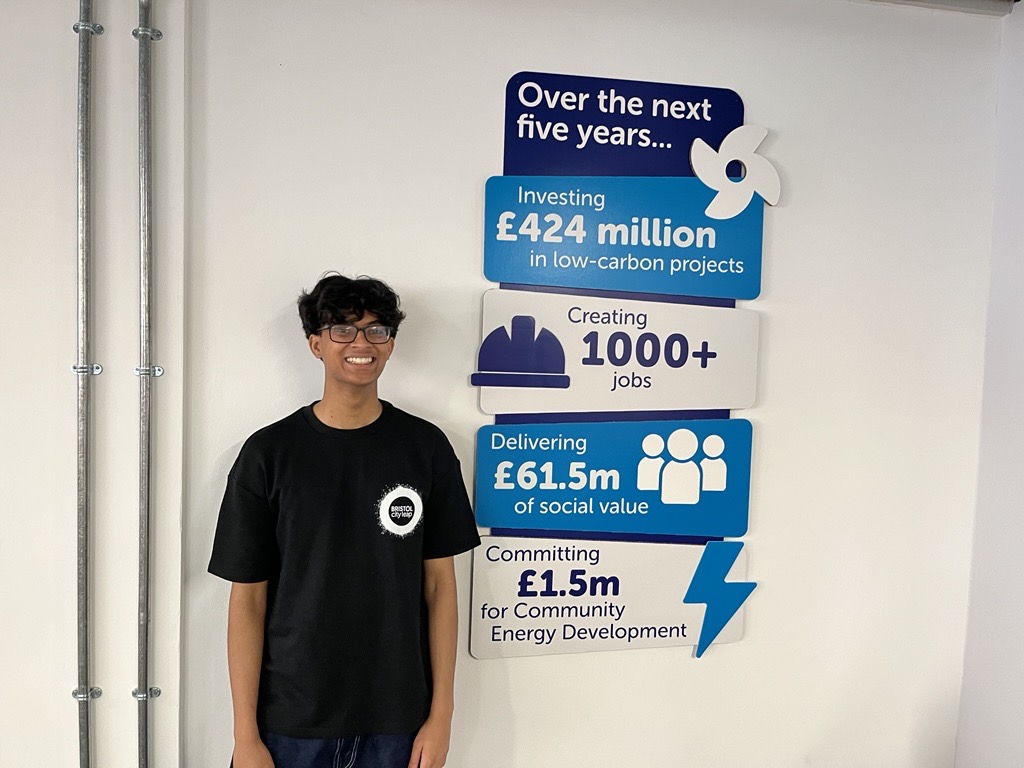
A guest blog by Sisir Kalavala
Who are you, what are you studying, and how did you find the internship?
My name is Sisir, and I study Biomedical Science at the University of Warwick. I am about to enter my third year.
I found the Bristol City Leap (BCL) internship on LinkedIn while looking for an opportunity to experience a different industry. I knew very little about the energy sector, but that was part of the appeal. I wanted to find out whether I could take the analytical skills I had developed through my degree and apply them somewhere completely unfamiliar.
The placement was originally planned for six weeks and was later extended to eight. By that point, there were pieces of work I wanted to see through properly, and I was enjoying the opportunity to keep contributing to the team.
What were you originally hired to do?
I joined BCL to support the Bright Green Homes scheme, mainly by helping the team identify and reach households that might be eligible for funded home energy improvements.
The starting point was a very broad housing dataset covering property type, tenure, Energy Performance Certificate ratings and location. The difficult part was not finding possible directions in the data. It was narrowing them down to a few ideas that might actually be useful. I developed a method for identifying concentrations of potentially eligible homes and comparing them with streets where residents had already received retrofit improvements. From this, I produced maps, a ranked list of areas and recommendations that the team could use to focus its outreach.
I also designed Bright Green Homes flyers and contributed to a Meta advert. The materials changed substantially, including the layout, colour scheme, messaging and call to action. The aim was to make the next step as clear as possible while recognising that residents may naturally have questions about eligibility, disruption and how a fully funded offer works.
BCL’s Customer Operations Manager managed this work and kept bringing me back to the resident experience. Her questions made me think beyond whether a flyer was accurate or visually tidy and ask whether somebody seeing the programme for the first time would feel reassured enough to respond. That changed how I approached both the analysis and the communications.
What other projects did you work on?
My role became broader quite quickly. Much of the internship involved getting oriented, asking questions and then trying to produce something that another person could genuinely use.
I worked with BCL’s Social Value Coordinator on a social value proposal linked to a local hospital. I looked at the green spaces already available around the buildings and explored how clean air and opportunities for exercise could support the proposal. This was one of the places where my Biomedical Science background connected directly with the work, because it encouraged me to think about the environment from the perspective of patients, visitors and staff.
Before the internship, “social value” was a phrase I only partly understood. Working on the proposal made it more concrete. I began to see that an environmental project can be judged not only by what it installs or saves, but also by whether it makes a place healthier, more accessible or more useful to the people around it.
I also supported early-stage work exploring solar PV and battery storage for blocks of flats and other complex housing types. I helped draft an initial project document and analysed housing data on walk-up blocks to identify areas that might justify further investigation. I found this stage of project development interesting because the answer was rarely obvious. The work was about reducing a large field of possibilities into a more credible starting point, while recognising that technical, financial and delivery questions would still need to be worked through.
For the local Electric Vehicle Infrastructure, I combined GIS mapping, data analysis and research to support the identification of priority areas for public charging infrastructure.
Elsewhere, I built Power BI and Smartsheet dashboards, updated Bristol City Leap Community Energy Fund materials, worked on resident communications and supported internal digital tools. The variety was one of the strengths of the internship. I could be working through an Excel dataset one day and trying to make sense of a new mapping or dashboard tool the next.
Most of the software I used, including GIS, Power BI, Smartsheet and Power Apps, was new to me. Learning through live work helped me understand why outputs need to be practical and useful, not just technically complete. By the end of the placement, I was less worried by the feeling of not knowing where to start. I had become more confident that I could ask the right questions, learn what I needed and improve the work as I went.
What did you learn about Bristol City Leap?
Before the internship, I associated decarbonisation mainly with technology and funding. I left with a more complicated picture. Technology matters, but so do trust, communication, project development and the practical details of delivery.
Bright Green Homes was the clearest example. I initially assumed that fully funded improvements would naturally attract overwhelming interest. In practice, residents may still be uncertain about whether they are eligible, what the work will involve and whether the offer can be trusted. That showed me that a worthwhile programme does not communicate itself. The route from first hearing about it to deciding to participate has to feel clear and manageable.
I also learnt that projects contributing to the same decarbonisation goal can require very different ways of thinking. Targeting a household grant, developing an idea for apartment blocks and planning public charging infrastructure involve different people, data and constraints. There is no single formula that can simply be applied to every project.
The most useful lesson was that analysis only matters when it connects to a real decision. A map can look polished, and a dashboard can contain the right figures, but neither is useful unless someone understands what to do with it. That is something I will carry back into my degree and future work.
What was the working environment like?
The team was supportive from the beginning, but what I appreciated most was that support did not mean being given every answer. I was trusted to try things for myself, make changes and return with something that could be discussed and improved.
BCL’s Social Value Coordinator was my main point of contact and gave me the confidence to explore work beyond my original brief while remaining someone I could approach when I needed direction. BCL’s Customer Operations Manager taught me to view the Bright Green Homes scheme through the resident journey and to think seriously about clarity and trust. One of BCL’s Project Manager encouraged me to look beyond the immediate task and connect individual pieces of work with the wider purpose of a project. BCL’s Senior Communications Coordinator sharpened my attention to branding and detail, particularly the difference between information being technically correct and being effective for its intended audience.
One of my favourite examples of the team culture was delivering Bright Green Homes flyers door to door with BCL’s Social Value Coordinator. It was not something she needed to do herself, but she was willing to get involved. As the placement progressed, moments like that made me feel less like an intern observing from the edge and more like part of the work.
What advice would you give another student?
Do not think of yourself as “just the intern”, but do not feel that you need to prove yourself by pretending to know everything either. Ask questions, learn who can help with different problems and be willing to show unfinished work early enough for feedback to improve it.
I would also ask what a piece of work will be used for, not only how to complete it. Understanding the person or decision at the other end of a spreadsheet, map or flyer makes it much easier to produce something useful. Being unfamiliar with an industry does not mean your perspective has no value, but it does mean you need to listen carefully and stay open to having your assumptions corrected.
Any final thoughts?
I arrived at Bristol City Leap expecting to analyse housing data for one programme. Eight weeks later, I had contributed to work across retrofit, renewable energy, electric vehicle infrastructure, social value and digital tools. I did not leave as an expert in all of those areas, and that is not really what the internship was about.
The internship did not give me a definite answer about what I want to do after university. It gave me something more realistic and, for now, more useful: confidence that I can enter an unfamiliar industry, admit what I do not know, learn quickly and still contribute something worthwhile.